
Rotator Cuff Tear: A Complete Guide for Patients
It might start as a dull ache when reaching overhead, or a sharp pain that wakes you in the night. For a tradesperson, it is the moment they can no longer lift their arm above shoulder height on site. For a recreational swimmer, it is the persistent weakness that appears mid-stroke and refuses to resolve. For a parent, it is broken sleep, night after night, caused by pain on the affected side.
Rotator cuff tears are one of the most common causes of shoulder pain and disability in Australian adults, affecting people across all ages and activity levels. Over 700,000 Australians are currently affected by rotator cuff injuries, with an incidence rate of approximately 13.3 cases per 1,000 individuals. While severity varies considerably, from small partial tears to large full-thickness ruptures, all presentations benefit from early assessment by a qualified rotator cuff tear specialist (orthopaedic surgeon). This guide explains what the rotator cuff is, how tears occur, what symptoms to recognise and what rotator cuff injury treatment options are available. It also outlines how AVA Orthopaedics provides specialist-led online orthopaedic consultations, giving patients across Australia access to expert shoulder assessment without the wait or the travel.
What Is the Rotator Cuff and Why Does It Matter?
The rotator cuff is a group of four muscles and their tendons that surround and stabilise the glenohumeral joint, the ball-and-socket joint of the shoulder. The four muscles are the supraspinatus (which initiates arm elevation and is the most commonly torn), the infraspinatus (responsible for external rotation), the teres minor (which assists rotation and joint stability), and the subscapularis (the largest of the four, responsible for internal rotation and anterior joint stability).
Together, they perform two essential functions: dynamically stabilising the humeral head within the glenoid socket during movement, and generating the shoulder's capacity for elevation, rotation and reaching. Without an intact rotator cuff, everyday tasks like lifting, reaching overhead, carrying loads or sleeping comfortably on the affected side become difficult or impossible.
Rotator cuff pathology exists on a spectrum, from tendinopathy and partial thickness tears through to full-thickness and massive tears involving multiple tendons. Understanding where a patient sits on this spectrum is central to guiding appropriate treatment for shoulder injuries.
How Do Rotator Cuff Tears Occur?

Rotator cuff tears develop through two distinct mechanisms, each with different implications for shoulder injury treatment planning.
Acute Traumatic Tears
Acute tears result from a single high-energy event, such as a fall onto an outstretched arm, a forceful lifting injury, or a shoulder dislocation. The onset is sudden, with immediate severe pain and rapid loss of shoulder function. These tears are more common in younger, active patients and most frequently involve the supraspinatus tendon. Early assessment by a rotator cuff tear specialist is critical: prompt diagnosis allows timely consideration of surgical repair before tendon retraction and muscle changes complicate the picture.
Degenerative Tears
Degenerative tears develop gradually through cumulative tendon wear, driven by repetitive overhead activity, age-related reduction in tendon vascularity, acromial morphology and longstanding shoulder impingement syndrome. More than 50% of individuals over the age of 50 have symptomatic or asymptomatic rotator cuff tears. Patients often describe a prolonged history of shoulder discomfort that has worsened over months or years, sometimes becoming acutely symptomatic following a minor incident superimposed on pre-existing tendon degeneration.
Recognising the Symptoms of a Rotator Cuff Tear

Symptoms vary depending on tear size, mechanism and the individual patient. Some presentations are dramatic and immediately disabling; others develop gradually over months before prompting specialist review. Common features include:
- Anterior or lateral shoulder pain, often described as a deep ache, provoked by lifting or reaching overhead
- Night pain: difficulty sleeping on the affected side is a hallmark symptom of significant rotator cuff pathology
- Weakness with overhead activities, lifting and reaching behind the back
- A painful arc of movement between approximately sixty and one hundred and twenty degrees of shoulder elevation
- Crepitus or clicking sensations with shoulder movement
- In complete tears: profound weakness and an inability to actively elevate the arm against gravity
Symptom severity does not always correspond with tear size. Some patients with large full-thickness tears report manageable pain, while those with partial tears can experience significant functional limitation. This is precisely why imaging is essential for accurate diagnosis and why assessment by a shoulder specialist should not be delayed or replaced with self-management alone. Patients experiencing these symptoms are encouraged to seek specialist review rather than continuing without a clear diagnosis.
How Is a Rotator Cuff Tear Diagnosed?
Accurate diagnosis combines a detailed clinical history with appropriate imaging. The history covers onset, mechanism, symptom progression, functional impact and prior treatment.
Three imaging modalities are used in rotator cuff assessment:
- Plain X-ray assesses acromial morphology, calcific deposits, glenohumeral arthritis and superior humeral head migration in massive tears.
- Ultrasound a dynamic, cost-effective first-line imaging tool with high sensitivity for partial and full-thickness tears in experienced hands.
- MRI is the gold standard, characterising tear size, location, degree of tendon retraction and muscle atrophy, all of which directly inform rotator cuff injury treatment planning.
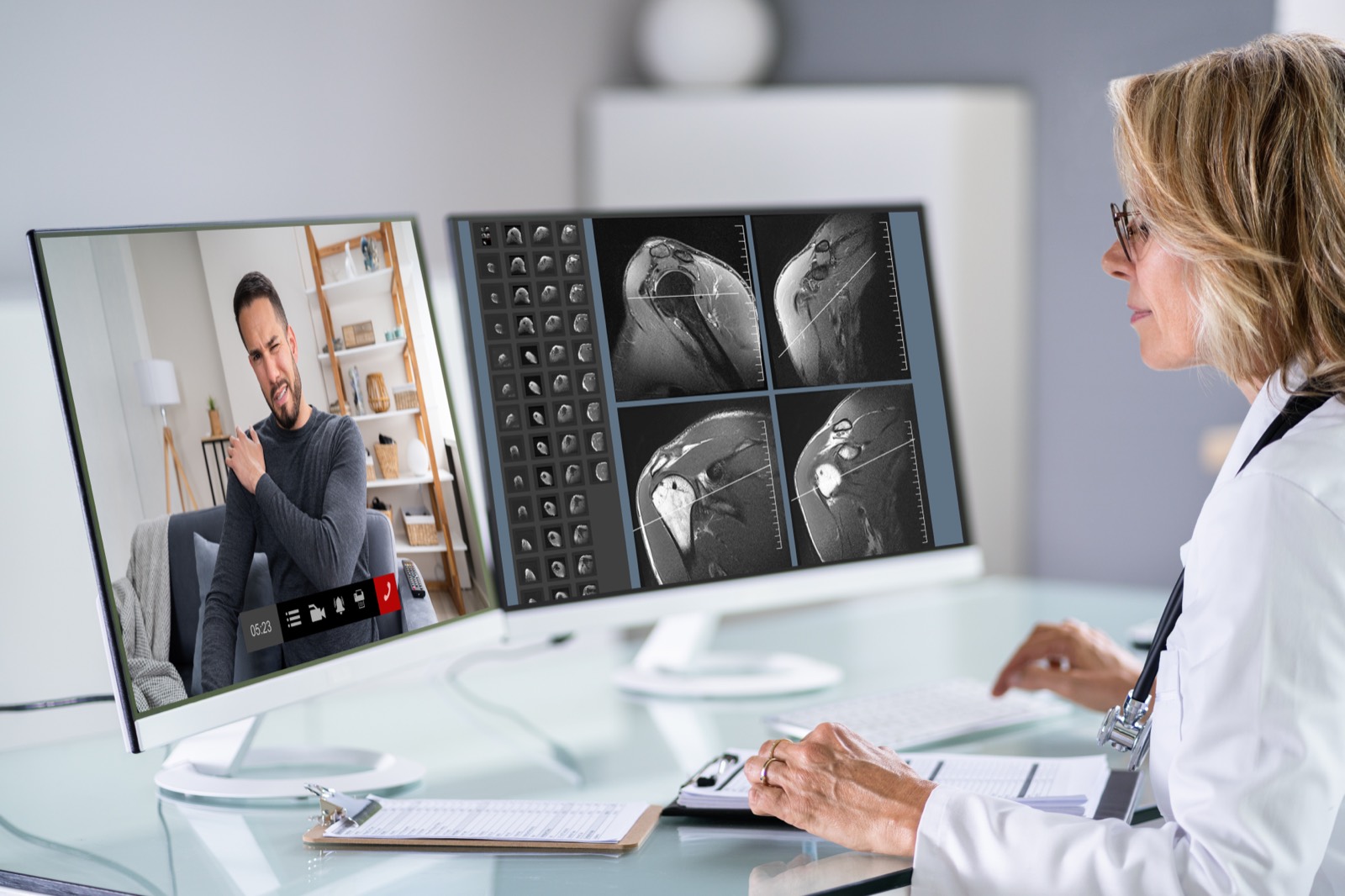
AVA Orthopaedics online consultations include a specialist-led review of all available imaging. Patients receive expert diagnostic interpretation of their ultrasound, MRI or X-ray findings from anywhere in Australia, without attending a clinic in person. Where imaging has not yet been obtained, the specialist provides clear guidance on which investigations are required and how to arrange them locally.
Rotator Cuff Injury Treatment: The Non-Surgical Pathway
Not all rotator cuff tears require surgery. For many patients, a structured conservative management programme delivers meaningful improvement in pain, strength and function. Conservative management is typically most appropriate for partial thickness tears, small full-thickness tears in lower-demand patients, elderly patients with chronic tears and minimal functional limitation, and those with significant medical comorbidities that increase surgical risk.
A structured non-surgical rotator cuff injury treatment programme typically includes:
- Physiotherapy: the cornerstone of conservative management, targeting rotator cuff strengthening, periscapular stabilisation, postural correction and range of motion restoration. Adherence to a physiotherapy programme is one of the strongest predictors of a successful non-surgical outcome.
- Activity modification: targeted load management to protect the injured tendon while active rehabilitation continues.
- Corticosteroid injection: subacromial injection for short-term pain relief and facilitation of physiotherapy engagement in appropriately selected patients.
- Platelet-Rich Plasma (PRP): an emerging adjunct for partial thickness tears, best discussed during a specialist consultation in the context of current evidence and individual presentation.
Symptomatic improvement typically occurs gradually over weeks to months. Specialist oversight ensures the programme is monitored and adjusted as needed, and that escalation to surgical management occurs at the right time when conservative care has not delivered sufficient improvement.
Rotator Cuff Injury Treatment: The Surgical Pathway
Surgical intervention is typically indicated for acute full-thickness tears in younger, active patients; for failed conservative management; for large or massive tears causing significant functional deficit; and for tears associated with shoulder instability.
The most common approach is arthroscopic rotator cuff repair, a minimally invasive procedure performed under general anaesthesia, in which the torn tendon is reattached to the humeral footprint. In cases of irreparable, massive tears, more complex procedures, such as superior capsular reconstruction or tendon transfer, may be considered and discussed during the specialist consultation.
Post-operative recovery expectations, including immobilisation requirements, physiotherapy milestones, and return-to-activity timelines, should be discussed directly with the treating surgeon prior to proceeding. AVA Orthopaedics provides specialist-led guidance on surgical options and helps patients understand whether operative management is appropriate for their presentation, supporting informed decision-making before any commitment to a surgical pathway is made.
Finding a Shoulder Specialist: Why Online Access Changes Everything

For many Australians experiencing shoulder pain, accessing subspecialty orthopaedic care is not straightforward. Patients searching for a shoulder specialist near me frequently encounter long waiting lists, limited local availability of subspecialty expertise and referral pathways that can take weeks to navigate. In rural and regional areas, the barriers are greater still.
AVA Orthopaedics was established to address these barriers directly. As a telehealth-only orthopaedic specialist service, AVA Orthopaedics provides patients across Australia with access to expert shoulder assessment via secure online video consultation - without the wait, the travel or the uncertainty of not knowing where to turn.
An online shoulder consultation with AVA Orthopaedics is a comprehensive specialist assessment, not a triage service. Each appointment includes:
- A thorough clinical history and symptom review covering onset, mechanism, progression and functional impact
- Detailed interpretation of all available imaging: ultrasound, MRI and plain X-ray reviewed by an orthopaedic specialist with subspecialty shoulder experience
- A personalised rotator cuff injury treatment plan with clear recommendations on surgical versus non-surgical management
- Referral coordination and colleague-to-colleague referral where operative intervention is indicated
Patients do not need to wait weeks for an initial specialist opinion. For rotator cuff injuries, where delays can allow a manageable tear to progress to a more complex and harder-to-treat injury, timely access makes a meaningful clinical difference. There is no need to search for a shoulder specialist near me. Rotator cuff tear specialist advice is available via secure video consultation from anywhere in Australia.
Book an Online Shoulder Assessment
A rotator cuff tear, whether acute or longstanding, partial or full-thickness, requires specialist assessment to determine the most appropriate treatment pathway. Without accurate diagnosis and a clearly structured plan, a manageable injury can progress to a more complex one, narrowing the window for effective conservative management or optimal surgical outcomes.
AVA Orthopaedics offers trusted, specialist-led online orthopaedic consultations accessible from anywhere in Australia. For patients who have spent time searching for a shoulder specialist near me only to encounter lengthy waiting lists and limited local options, AVA Orthopaedics provides a direct pathway to subspecialty consultations. Specialist rotator cuff injury treatment advice is available via a secure video consultation from the comfort of home, with no referral delay and no travel required.
Before your appointment, it helps to have the following ready:
- Any existing imaging reports and files, including ultrasound or MRI results
- A clear description of your symptoms: when they began, how they have progressed, and which activities are most affected
- Details of any treatment already undertaken, including physiotherapy, injections or medication
Book your online shoulder assessment with AVA Orthopaedics today.